

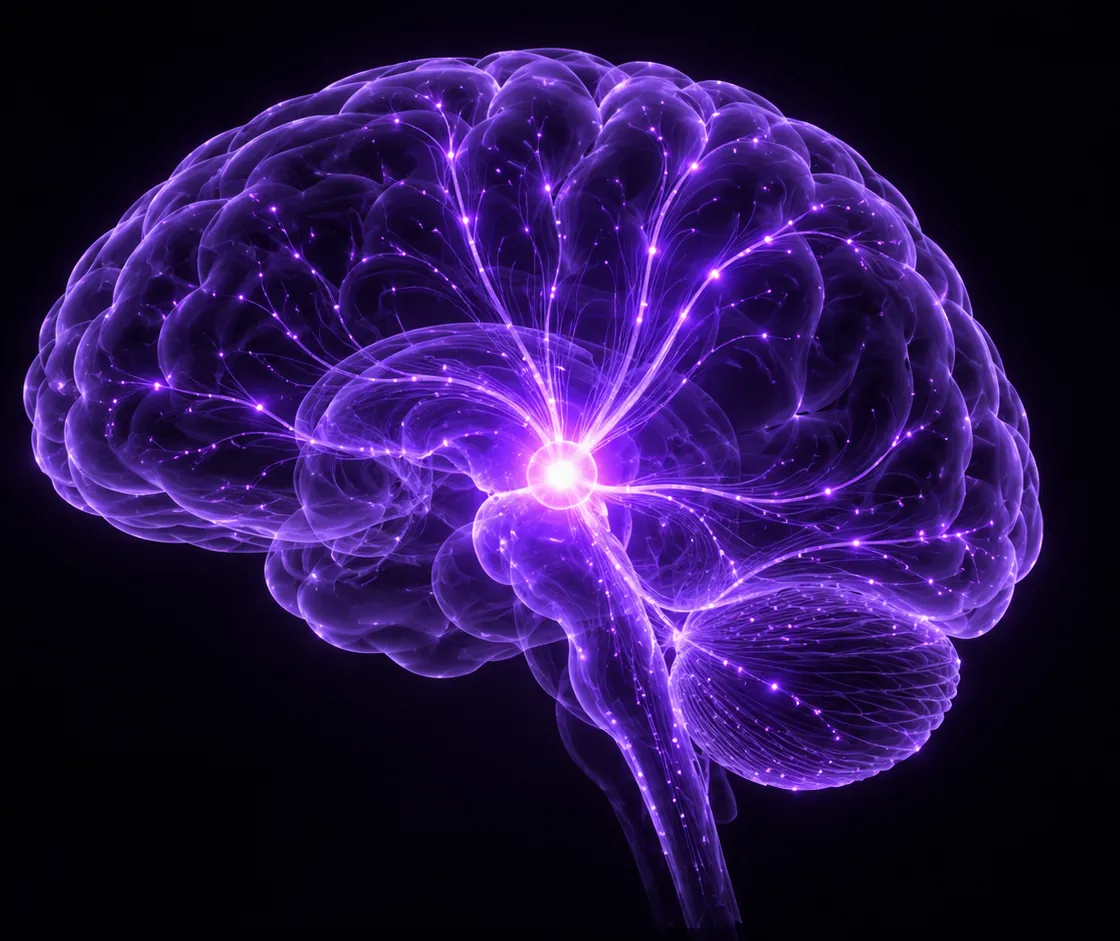
Deep in the brainstem sits a tiny cluster of cells called the locus coeruleus, Latin for “blue spot”. It is the brain’s main source of noradrenaline, a chemical linked to alertness, attention and learning. For a long time it was pictured as a single loudspeaker, sending the same signal to the whole brain.
A study in the journal Nature argues that picture is too simple. Working in mice, the researchers found groups of neurons that send their signals to different places and seem to do different jobs.
What the team did
The work comes from the Allen Institute. The first author named in coverage is Zhixiao Su, and Jeremiah Cohen, of the Allen Institute for Neural Dynamics, is among the senior authors. According to a ScienceDaily summary, the team imaged about 35,000 noradrenaline-producing neurons across whole mouse brains. It also analysed the genes of about 400,000 cells, recorded neurons’ activity, reconstructed individual cells and ran behaviour tests.

The funding came from the US National Institutes of Health’s BRAIN Initiative.
Two ends of one structure
| Part of the locus coeruleus | Where its fibres go | What it seemed to do in mice |
|---|---|---|
| Upper (dorsal) | Mostly the cortex and the front of the brain | More active during learning |
| Lower (ventral) | The brainstem and spinal cord | Seemed to shape how mice responded to opportunities around them |
The cells’ genes also changed gradually from top to bottom, in step with where they sent their fibres. The longest fibres were remarkable: they averaged about 35 centimetres, and one reached 70.32 centimetres, according to the summary.
Why researchers care
If a single nucleus can send tailored messages, then switching all of it on or off would be a blunt way to study it. Researchers outside the team who spoke to The Transmitter about an earlier preprint of the work, including Nelson Totah of the University of Helsinki, described it as basic groundwork the field needed. They also said that gene profiles could help scientists record from, and control, specific groups of these cells.
That is the same logic behind this year’s Nobel Prize in Medicine for optogenetics: to understand the brain, you need to reach specific cells. For a very different route to the brain, see brain implants giving people who lost their speech a voice again.
What this does not show
Everything here was done in mice. Nothing in the study tests people. Links to depression, anxiety, attention disorders or Alzheimer’s disease are hypotheses, and the summary also calls a similarity with the dopamine system suspected, not shown.

What it means
Our reading: this is a basic-science map, not a treatment. Its value is that it replaces one big question, “what does the locus coeruleus do?”, with narrower ones, such as what each group of cells does and where it sends its signal. Whether the human version is organised the same way is still unknown.
What we could not confirm
We did not open the paper in Nature or the Allen Institute’s release, so the numbers come from secondary coverage. Reports differ on how many neurons were fully reconstructed, so we leave that figure out. We could not confirm the publication date, which coverage gives differently.


Leave a Reply