

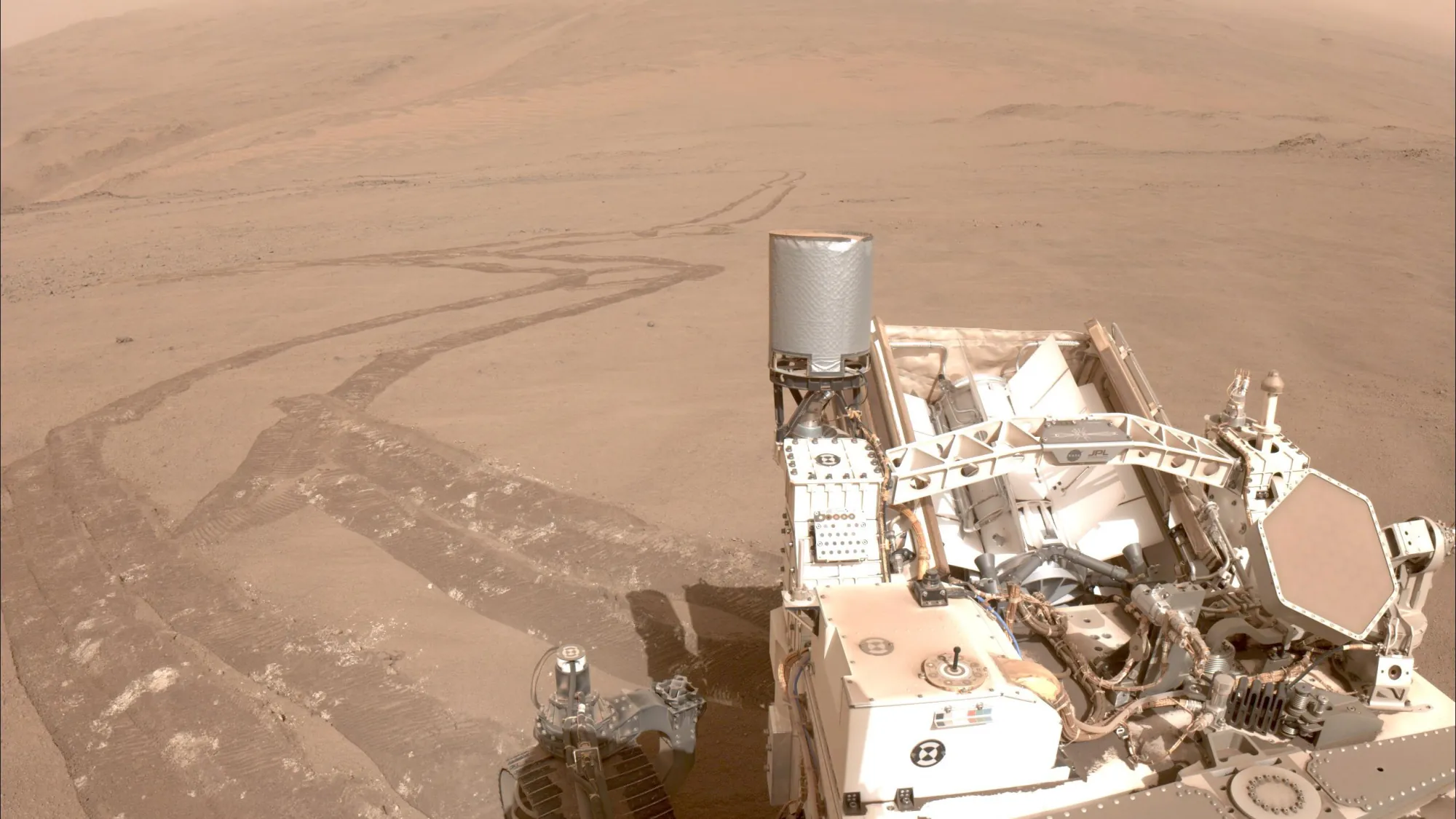
NASA’s Perseverance rover has driven further than any other rover on Mars. On 11 October, a short drive took its odometer to about 45.22km (28.10 miles), passing the 45.16km (28.06 miles) recorded by Opportunity, according to NASA’s Jet Propulsion Laboratory (JPL).
The record is also a story about autonomy. Most of Perseverance’s driving has been done by the rover itself, using a system called AutoNav. Here is how it works, and what people still decide.
The record in numbers
Opportunity, which landed on Mars in January 2004, took nearly 15 years to cover its distance. Perseverance, which landed on 18 February 2021 carrying the Ingenuity helicopter, did it in about five, according to IEEE Spectrum. JPL puts it at about five and a half years. IEEE Spectrum reports that the final drive that clinched the record was about 91m.
The original mission was never meant to drive this far. “The original mission called for no more than 12.4 miles of driving,” said Steven Lee, project manager for the Curiosity and Perseverance rovers. NASA has approved a mission extension that began in October 2026 and runs to about the end of 2028.
Where it is heading
Perseverance is travelling towards an area called Idubi, in a region named Lac de Charmes off the western rim of Jezero Crater. Scientists hope to find signs of ancient hydrothermal systems there, according to JPL.
How AutoNav drives the rover
AutoNav lets the rover photograph the terrain while it moves, build a 3D map of hazards and plan its own path between waypoints that planners on Earth set. The team calls this “thinking while driving”. Perseverance can cover up to 412m in a single Martian day.
JPL says more than 90% of the rover’s total distance has been driven with AutoNav, compared with about 5% for the first AutoNav system on Opportunity. IEEE Spectrum puts the rover’s self-driving share at about 90% of the time, the highest of any Mars rover, and notes that Spirit drove itself 23% of the time.
| Rover | How much it chose its own path |
|---|---|
| Opportunity | About 5% |
| Spirit | 23% (IEEE Spectrum) |
| Perseverance | About 90% of its distance |
The rover has also become a much better observer. Sojourner, the 1997 rover, assessed its path using 20 measurement points. Perseverance processes 600,000 with each look, JPL says. IEEE Spectrum adds that AutoNav can drive at up to 120m an hour, and that the rover has a second processor to handle the extra image processing.
Why humans still plan the route
Self-driving does not mean unsupervised. The science team sets destinations, and separate teams plan routes. IEEE Spectrum reports that humans add location-based warnings, such as avoiding areas of sandy ripples, because onboard autonomy measures the shape of the terrain but not what it is made of. Images from orbit reach about 25cm resolution, which still cannot show every obstacle.
Mark Maimone, a JPL robotics engineer who designed the self-driving software for Spirit, Opportunity, Curiosity and Perseverance, told IEEE Spectrum the software was tested with millions of simulations and extensive field work. “It hasn’t steered us wrong yet,” he said. JPL quotes him saying “Perseverance is a better driver than the one that landed, and we’re not done.”
A rover that has kept learning
IEEE Spectrum says the rover’s slope limit was raised from under 14 degrees in its first three years to up to 24 degrees. One drive on 10 December 2025 covered 246m in 2 hours 35 minutes, using 53 pairs of navigation-camera images. The rover also spent about two months driving without autonomy in complex terrain while its software was retuned. A feature called Mars Global Localization lets it work out its own position more precisely, which could allow longer autonomous drives.
The same interview mentions that, late last year, an AI, Anthropic’s Claude, planned a 400m drive from orbital images, with humans reviewing it and making a couple of adjustments. That detail comes from IEEE Spectrum alone, and JPL’s release does not mention it.
What it means
Perseverance’s record is a reminder that robots can do much of the driving on another world. The team still sets the goals and checks the work. We will update this article if JPL and IEEE Spectrum give different figures for the record.
Leave a Reply