

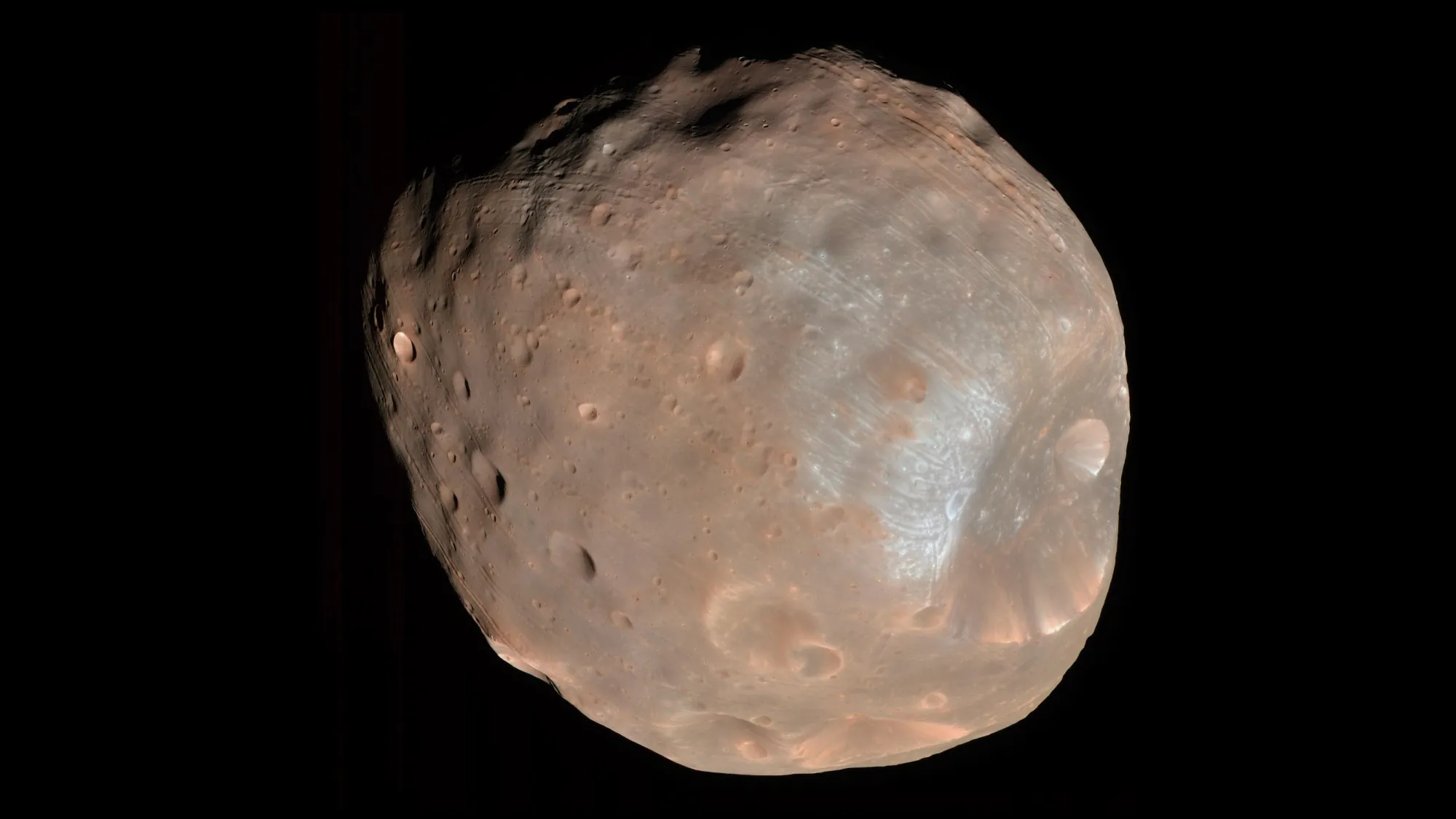
Japan’s space agency, JAXA, has launched its Martian Moons eXploration (MMX) probe. Its goal is to bring back about 10 grams of soil from Phobos, the larger of Mars’s two moons, in 2031. Science News reports that the launch took place on 19 October.
JAXA had scheduled lift-off for 4:41am on 20 October in Japan, which is 8:41pm on 19 October in the UK. The probe flew on an H3 rocket from the Tanegashima Space Center. We have not found a report on how the flight went beyond the launch itself, so the details of the first hours are not yet confirmed.
The plan, step by step
The journey is long, and the sample will not be home for another five years:
| When | What happens |
|---|---|
| October 2026 | Launch on an H3 rocket from Tanegashima |
| 2027 | After about a year of travel, the probe reaches Mars’s neighbourhood and heads for Phobos |
| 2027 to 2030 | About three years in orbit alongside Phobos, with two landings on its surface |
| 2030 | The probe leaves Mars and passes Deimos, the other moon, on the way home |
| 2031 | The return capsule separates, with recovery planned in Australia |
JAXA says the sample will be about 10 grams, with a goal of more than 10. Science News compares that to roughly four US pennies. The probe will collect it in two ways: a drill that reaches about 2cm into rock, and pressurised gas to gather loose material from the surface. A rover called Idefix will scout for suitable places to collect. JAXA’s own page does not mention the rover, so that detail rests on Science News.
Why scientists want Phobos
Phobos may hold more than its own history. Science News reports that impacts on Mars may have thrown grains of Martian rock onto Phobos. Some of them could be ancient, dating from when the moons formed. Others could be fresher debris from later collisions. Some might come from deeper in the Martian crust than any sample scientists have so far.
If researchers can date those grains, they may be able to improve the calendar of impacts near Mars. For now, scientists estimate that timing using a timeline built from the Moon. That is why Phobos dust matters beyond Phobos itself.
The hard part: telling which grains are from Mars
Finding Martian grains is not simple. According to Science News, researchers would have to confirm which grains actually came from Mars. The grains would have no geological context, the way rock in the ground does, and they would be weathered by radiation in space.
Scientists quoted in the article include Michael Zolensky of NASA’s Johnson Space Center, Tomoki Nakamura of Tohoku University, Kiyoshi Kuramoto of Hokkaido University and Nancy Chabot of the Johns Hopkins Applied Physics Laboratory. Briony Horgan of Purdue University and Vicky Hamilton of the Southwest Research Institute commented without being involved in the mission.
The title of a 2024 review by Kuramoto, which Science News cites, puts the open question plainly: the origin of Phobos and Deimos is “awaiting direct exploration”. Bringing back material from the surface is how MMX aims to supply that direct evidence.
Who gets the samples
JAXA will sort and catalogue the material, then share portions with other institutions. NASA’s Johnson Space Center will receive 15 percent, Science News reports. The capsule is expected to land in Australia’s outback, as capsules from Japan’s earlier Hayabusa missions did.
Science News also notes that three earlier Russian missions to Phobos failed, which is a reminder of how difficult the target is.
What to watch next
Over the coming days, the key question is whether the probe is confirmed to be on course for Mars. After that, the next milestone is the arrival at Mars’s neighbourhood in 2027.
We have relied on JAXA’s mission page for the plan and on Science News for the launch and the science. We will update this article when JAXA publishes news on the first weeks of the flight.


Leave a Reply