

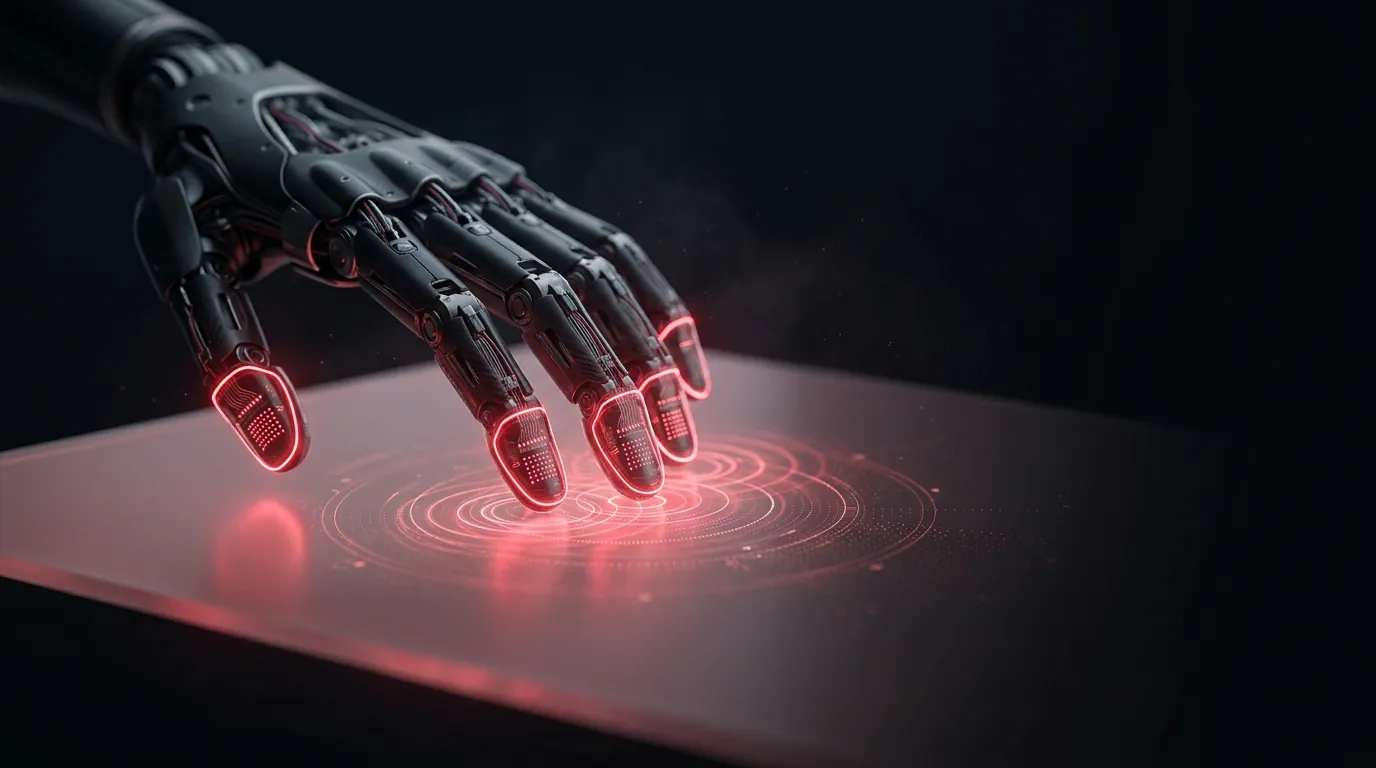
Most AI-driven robots rely mainly on cameras. Daimon Robotics argues that, for tasks where a robot has to handle objects, vision is not enough and touch matters. The company showed what it calls a tactile world model at IROS 2026, a robotics conference, and The Robot Report spoke to one of its executives.
Here is what the company says it has built, what it demonstrated and what it has not shown.
What the company says it is building
Daimon Robotics describes itself as a physical AI company focused on tactile intelligence. Its headline product is Daimon-TWM, a world model grounded in touch. The idea is to help robots reason about physical interactions instead of depending on vision alone. Robotics 24/7 says it uses physical interaction data for physical cognition, predictive decision-making and real-time control of dexterous manipulation. It launched in August 2026, and IROS was its first in-person public demonstration.
Daimon says it is an infrastructure provider rather than a developer of general-purpose AI models. “By building tactile intelligence, we’re actually playing the role as an infrastructure provider,” Dr Zhu, the company’s partner and vice-president of technology, told The Robot Report. “We’re not aiming to be a foundation model developer.”
The sensors and the data
The company’s DM-Tac sensors are vision-based tactile sensors. Robotics 24/7 says they cover more than 12 tactile modalities with more than 110,000 sensing units, and were shown in live demonstrations including underwater sensing, durability testing and detecting an empty package.
Models need data, and Daimon has a system to collect it. Its Data-Nexus acquisition system combines collection devices, networking, processing pipelines and evaluation benchmarks to produce physical interaction data for training. The Robot Report says the company records human interactions with a collection device called Umi. It discussed more than 10,000 hours of data collection so far and set a target of more than 1 million hours of tactile data for a project called Daimon-Infinity. Both are targets and plans, not results we can verify.
What the demonstrations showed
At IROS 2026, the company showed robots doing fiddly tasks:
- Threading small engraved beads onto flexible string to make friendship bracelets, adjusting to contact conditions.
- Heat-transfer printing onto canvas tote bags, an autonomous multi-step task that covers placing the sticker, removing the film, hot stamping, curing and final placement.
- Collecting and packaging broken glass, which the company used to show that models trained on varied scenarios can be prompted for specific tasks.
What touch adds
According to The Robot Report, tactile sensing lets a robot check whether a component is properly seated, detect slippage, adjust its movement when a part behaves unexpectedly and close the loop between an action and its physical result. The company targets tactile feedback and control at 30 Hz, which is how often it wants the robot to update its sense of touch.
The honest caveats
Dr Zhu was frank about the state of the field. On simulation, he said: “Let’s be frank; it’s not good enough. It’s kind of terrible.” On his own model: “The model is not as intelligent as we think.” He also said that “Doing everything ourselves was not enough”, explaining why the company works with partners. The Robot Report names Lenovo Capital and Inovance Technology as key partners but does not say whether they are investors.
Daimon says it has moved beyond proof-of-concept work into industrial assembly lines and warehouses, with assembly and packaging as target applications. It has not named any customer, citing non-disclosure agreements. Neither report gives a price, a commercial release or a timetable.
What we do not know
Both reports are based on the company’s own account. We do not know where Daimon is based, how it is funded, or whether its systems outperform vision-only approaches in independent tests. We will update this article if customers, test results or products appear.

Leave a Reply