

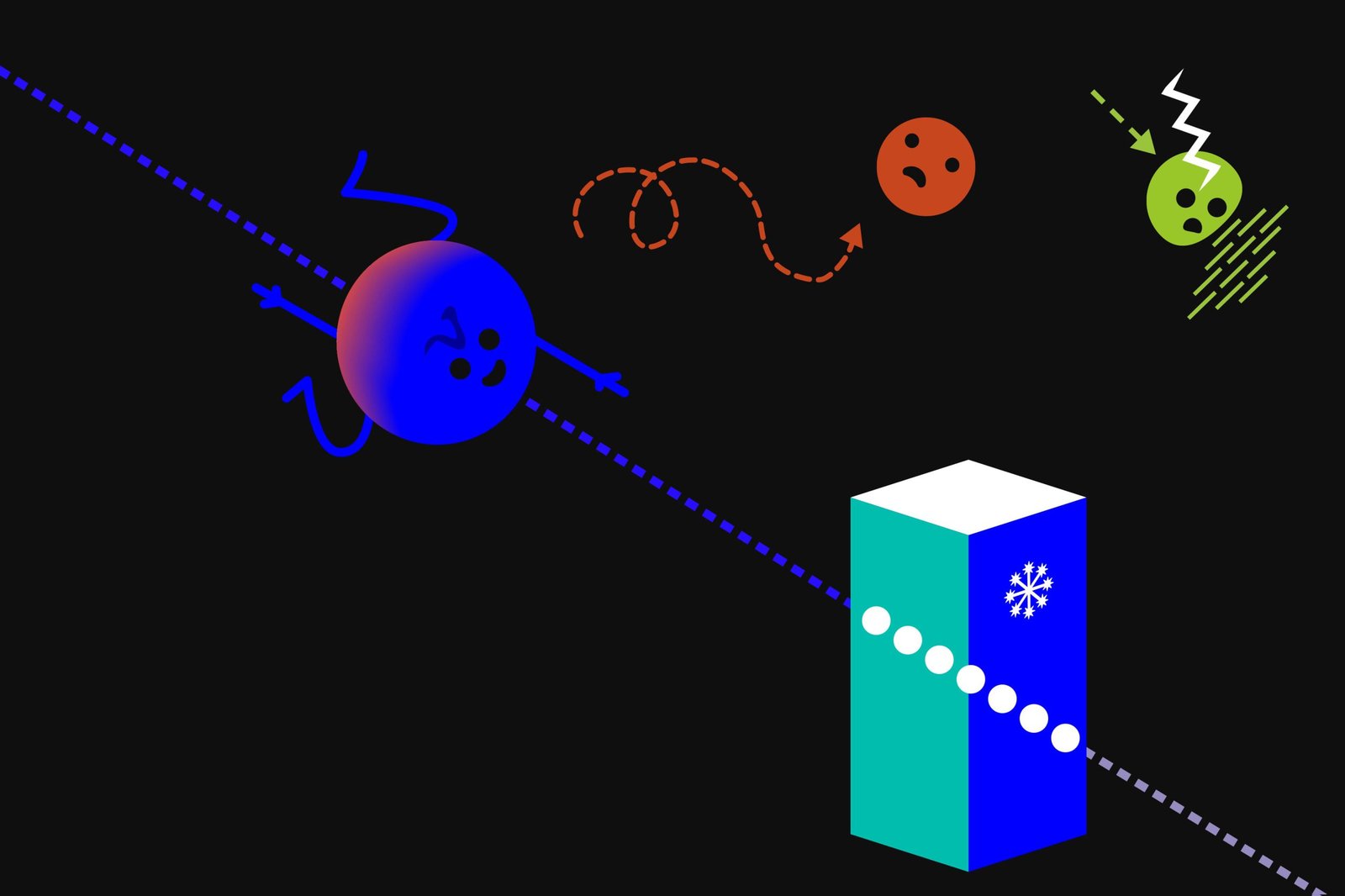
Francis Halzen has won the 2026 Nobel Prize in Physics for helping build a telescope out of Antarctic ice. The prize, announced on 6 October, honours “decisive contributions to the IceCube Neutrino Observatory and the discovery of high-energy neutrinos of astrophysical origin”. Halzen, born in Belgium in 1944, is a professor at the University of Wisconsin–Madison.
The particles that pass through you
Neutrinos are everywhere, but they rarely make themselves known. They pass through the Earth and through our bodies without us noticing. Only very rarely does a single neutrino hit an atomic nucleus, and that is what makes it possible, with the right equipment, to catch one.
They are worth the trouble. The Nobel Committee explains that the cosmos holds natural particle accelerators that fire out particles with up to a million times more energy than anything on Earth. Many other particles get bent or lose energy on the way to us, but neutrinos reach us without changing direction or losing energy. That means they can tell us things about the most violent places in the universe that nothing else can.
An idea from 1988
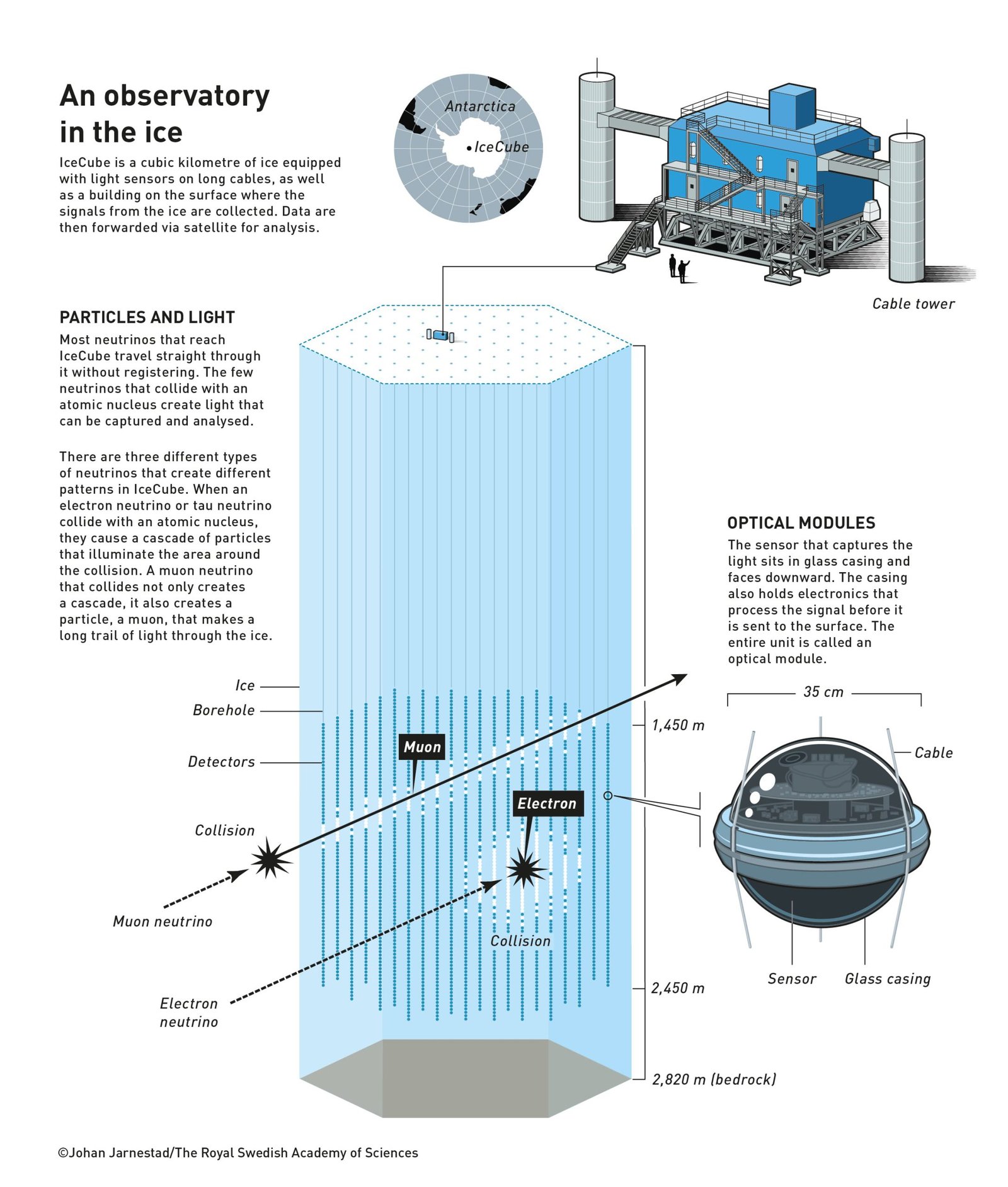
Halzen first presented his idea of catching neutrinos at the South Pole in 1988. When a neutrino collides with an atomic nucleus in clear ice, it produces a flash of light that sensors can pick up. The South Pole has advantages: the ice is free from many kinds of interference and the region is geologically stable, with no earthquakes. His idea won the support of other researchers, and a few years later preliminary tests of sensors in ice were done.
Because high-energy cosmic neutrinos are so rare, you need a huge volume of ice. IceCube covers a full cubic kilometre. Holes were drilled with jets of hot water and long strings of light sensors were lowered into them, at depths of roughly 1,450 to 2,450 metres, according to the Nobel Committee’s diagram. The observatory was finished in 2011.
What IceCube has found
Researchers soon found the first high-energy neutrinos and, a few years later, published their discovery of neutrinos that must come from far outside our solar system. In 2013 IceCube announced the first detection of high-energy neutrinos from beyond the solar system, a finding that won Physics World’s Breakthrough of the Year. In 2017 it spotted a high-energy neutrino coming from a supermassive black hole at the centre of a distant galaxy, in the direction of the constellation Orion. It has since found evidence of neutrinos from an active galaxy 47 million light-years away, in 2022, and from our own Milky Way, in 2023, the University of Wisconsin–Madison says.
Scientific American says IceCube helped launch “multimessenger astronomy”, which combines neutrino data with traditional telescopes and gravitational-wave detectors. Neutrinos are the least understood of the 17 known fundamental particles.
The man and the team
Halzen joined the Wisconsin faculty in 1972 and led the design of IceCube and its predecessor, AMANDA. Mark Pearce, chair of the Nobel Committee for Physics, says Halzen “has led an international team of researchers and engineers who have provided us with a fantastic instrument. His tenacity and scientific vision has paved the way for a new kind of astronomy.”
Halzen himself said: “I hope this reflects on the really courageous people who joined me in the beginning of this project.”
The prize is worth 12 million Swedish kronor and will be presented in Stockholm on 10 December. Scientific American notes that the US administration’s proposed 2027 budget would halve IceCube’s funding.
Illustration: © Johan Jarnestad/The Royal Swedish Academy of Sciences.


Leave a Reply