

A 673-person trial of a home headset that flashes light and plays sound at 40 pulses a second did not beat a sham device on its main goal. The company points to a result in mild disease, and that result has weaker support than the headline numbers suggest.
CTRL + ALT News | Science | Information checked on 24 November 2026
On 16 November 2026 Cognito Therapeutics announced the results of HOPE, the pivotal trial of its Spectris headset in Alzheimer’s disease, presented as a late-breaking talk at the Clinical Trials on Alzheimer’s Disease conference (CTAD) in Boston. The 12-month trial did not meet its primary endpoint. In a subgroup of people with milder disease, though, some measures leaned towards the device.
We read those results against two things most reports do not put side by side: the trial’s own entry in the ClinicalTrials.gov registry, and the smaller trial that came before it. We could not open the conference abstract itself, so the numbers below come from the company’s announcement (as republished by the Alzheimer’s Drug Discovery Foundation, ADDF) and from NeurologyLive’s detailed report of the talk. The results have not been peer-reviewed.
What the trial tested, and in whom
Spectris is an investigational device: a headset that delivers synchronised flashing light and sound at 40 hertz, meant to evoke 40 Hz “gamma” brain activity. Participants used it for an hour a day at home, and the control group used a sham version, according to NeurologyLive. The trial was double-blind, meaning neither participants nor staff knew who had the real device.
The registry entry (NCT05637801, sponsored by Cognito, last updated on 9 September 2026) shows:
- 673 participants enrolled, aged 50 to 90, with Alzheimer’s confirmed and a Mini-Mental State Examination (MMSE) score of 15 to 28. NeurologyLive reports that 663 were in the main analysis.
- 68 study sites, all in the United States. None is in the UK or Brazil.
- A primary endpoint called iADMARS: according to NeurologyLive, an equally weighted composite of the MMSE (a memory and thinking test) and ADCS-ADL (a scale of daily living), measured as change over 12 months.
- Participants were split in advance into a mild group (MMSE 21 to 28) and a moderate group (MMSE 15 to 20).
The main result: no separation from sham
In the main analysis, neither the primary nor the secondary endpoints differed significantly from sham, NeurologyLive reports. That is the result for everyone the trial was designed to test.
The mild-disease “signal”, in numbers
In the mild group (395 people), these were the results reported at the conference:
| Measure (mild group, n = 395) | Reported slowing vs sham | Difference | P value |
|---|---|---|---|
| ADCS-ADL (daily living) | 56% | 2.03 points | 0.016 |
| ADCS-iADL (instrumental daily living) | 53% | not reported in our sources | 0.034 |
| CDR-SB (disease severity) | 47% | 0.58 points | 0.004 |
| iADMARS (the primary composite) | 42% | not reported in our sources | 0.072 |
| MMSE (memory and thinking) | 29% | not reported in our sources | 0.369 |
Source: NeurologyLive’s report of the CTAD presentation.
A few things help to read this table:
- What “56% slowing” means. The sources do not give the formula. If it is the difference divided by the decline on sham, which is how such percentages are usually worked out, then people on sham lost about 3.6 points on ADCS-ADL over the year (2.03 ÷ 0.56) and about 1.2 points on CDR-SB (0.58 ÷ 0.47). Those are our calculations, not figures from the trial.
- The company’s own caution. A separate “per-protocol” analysis of 169 mild-group participants who used the device for at least six months with 70% adherence or better looked larger (82% on ADCS-ADL, 64% on CDR-SB, 73% on iADMARS). Cognito itself notes that such analyses are prone to bias from who sticks with a treatment and do not show cause and effect.
- The primary composite and the memory test did not reach nominal significance even in the mild group.
Why a result can be prespecified and nominal at once
Reports differ in how they describe the mild-group result. The company and NeurologyLive call it a prespecified subgroup, and they are right: participants were split by severity at the start. NatureWorldNews and NeurologyLive also call the results nominal and unadjusted for multiple testing, and they are right too. A result is “nominal” when its P value is below 0.05 on its own, without allowing for the fact that several measures were tested. Test enough measures and some will cross that line by chance.
We ran a simple check on the five measures in the table. Dividing 0.05 by five gives a stricter bar of 0.01. Only CDR-SB (0.004) clears it; ADCS-ADL (0.016) and ADCS-iADL (0.034) do not. This is a rough sanity check, not a verdict: statisticians use more refined methods, and the trial’s statistical analysis plan is not public. It does show that the picture depends heavily on one measure.
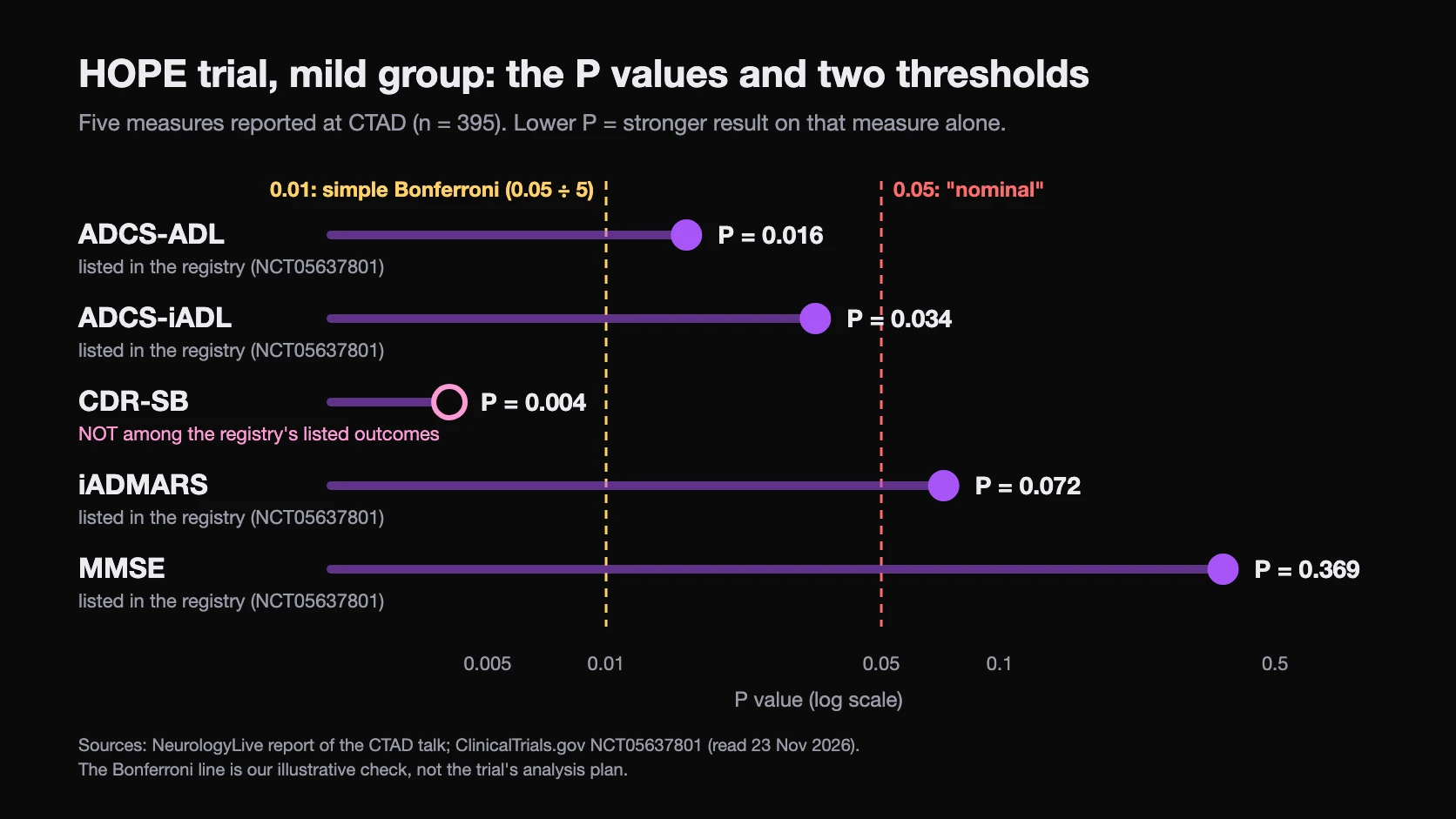
That measure is the one to look at twice. The registry entry we read lists the primary endpoint plus three secondary endpoints: ADCS-ADL, MMSE and ADCS-iADL. CDR-SB is not among them. The protocol may define more outcomes than the registry shows, and we cannot see the full plan. But the result with the strongest P value is for a measure that is not on the registry’s list, and that is a question for the authors to answer when they publish.
What the earlier, smaller trial showed
HOPE’s predecessor, OVERTURE, was a phase 2 trial of 76 people over six months, published in Frontiers in Neurology in 2024. Its primary measure did not separate the two groups (P = 0.68). The paper then describes its secondary results as “descriptive, exploratory” and notes that no correction for multiple comparisons was made; the MMSE showed 76% less decline in the active group, nominally significant.
The pattern repeated at a larger scale: a primary endpoint missed, then a nominal signal in a secondary or subgroup analysis. And one of the measures that looked promising in OVERTURE, the MMSE, was the weakest of the five in HOPE’s mild group (29%, P = 0.369). That is not proof that either signal is noise. It does show why the company’s next step is a dedicated trial in mild disease, not a conclusion.
Does the biology hold up?
The idea comes from experiments in mice. Li-Huei Tsai’s group at MIT reported that stimulating the brain at 40 Hz appeared to clear Alzheimer’s-linked plaques. The Transmitter reported in August 2024 that attempts to replicate this had failed, and that the neuroscientist György Buzsáki’s group at New York University had found it could not entrain 40 Hz gamma activity in two mouse models using flashing light. Their paper concluded that 40 Hz flicker “does not reliably reduce” amyloid load in the regions they studied. Bryce Mander, a University of California, Irvine, researcher quoted in the same article, put the field’s record on mouse results this way: “We’ve cured mouse-heimer’s thousands of times.”

None of that settles whether the device helps people. It is the reason independent scientists want a clean result in humans before accepting the mechanism.
Side effects, including seizures
The company reports no unanticipated adverse device effects. Adverse device effects occurred in 18.3% of the active group (333 people) and 15.5% of the sham group (330), most often headache (5.7% against 3.9%) and tinnitus (3.3% against 1.2%). Seizure, which the trial tracked as an event of special interest, occurred in 0.9% against 0.3%. NatureWorldNews adds that people with a history of seizures should take particular care with flashing-light devices.
What happens next, and what it means in the UK
- Regulators: Cognito says it will meet the US FDA to discuss a possible “De Novo” route for early symptomatic Alzheimer’s. The device has an FDA “breakthrough” designation, which speeds review and is not approval. NatureWorldNews reports that the company’s chief executive hopes for authorisation by the end of 2027, which is the company’s projection and not a regulatory decision.
- Publication: the company says it will submit the results to the New England Journal of Medicine. Until a peer-reviewed paper appears, the numbers stand as the company’s.
- Follow-up: an open-label extension study (NCT06245031) is continuing.
- The UK: the registry shows no UK trial sites, and we found no information on UK regulatory status or availability. Nothing in the sources says the device can be bought or prescribed in Britain.
- A warning about look-alikes: NatureWorldNews notes that light-and-sound products sold online were not tested in this trial. HOPE tested Cognito’s own device only.
The ADDF, which republished the company’s announcement and is quoted saying the mild-group signal raises “important questions that are worth exploring further”, is an investor in Cognito, so its comment is not independent.
For another case of reading an effect against its evidence, see another study where a link was found but the differences were small.
What would change the picture
A peer-reviewed paper with the full statistical analysis plan, the complete list of outcomes and the moderate-group results. A trial built for mild disease, with the primary endpoint fixed in advance. And independent comment: we looked for statements from Alzheimer’s charities and independent neurologists on these results and did not find any, apart from the company-linked comment above.
Sources: ClinicalTrials.gov, NCT05637801; Frontiers in Neurology, 2024 (OVERTURE); ADDF, republication of the Cognito announcement, 17 November 2026; NeurologyLive, 17 November 2026; NatureWorldNews, 19 November 2026; The Transmitter, 21 August 2024.




Leave a Reply