

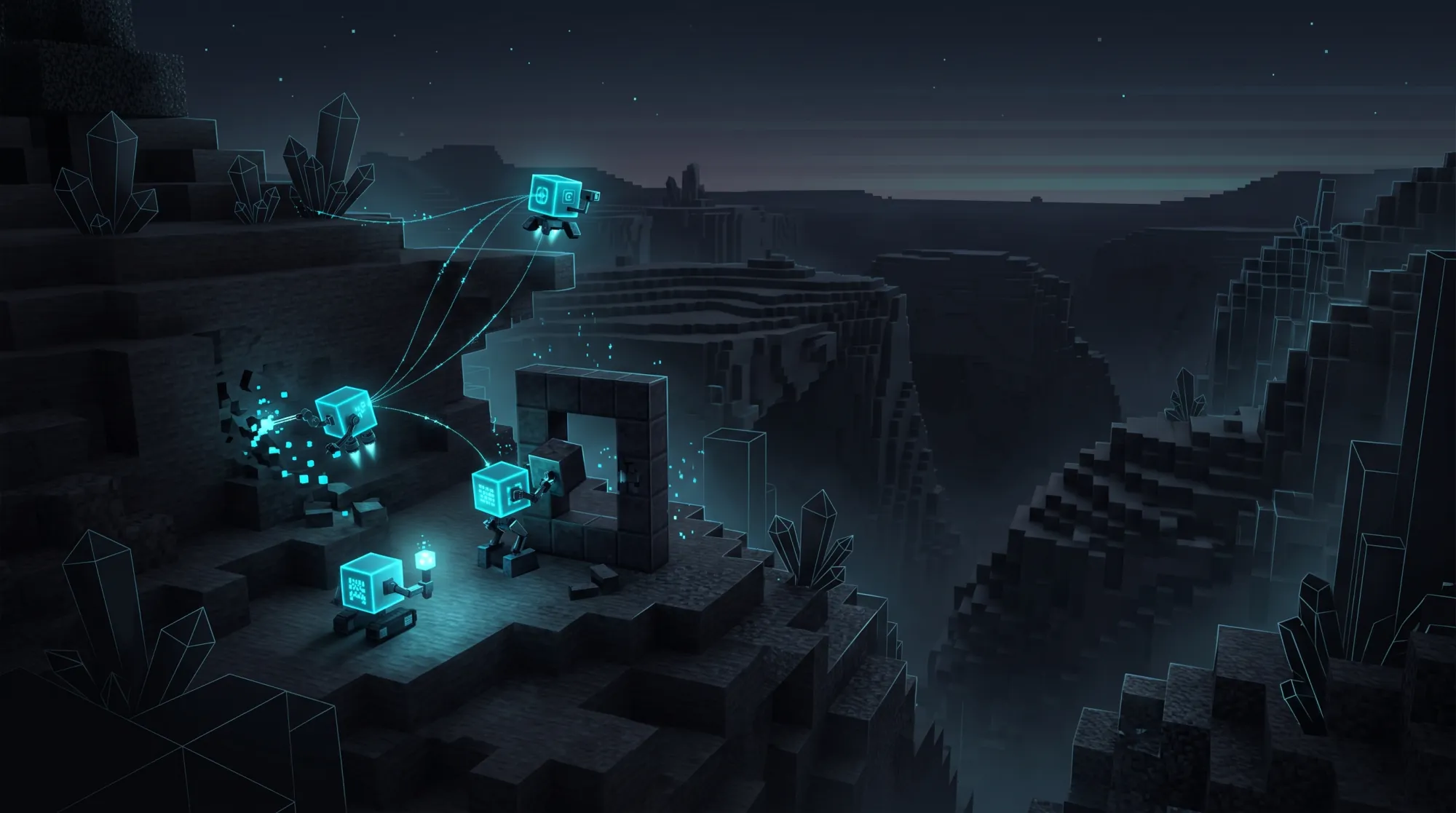
A team of four AI agents has defeated the Ender Dragon, the final boss of Minecraft, with no human input during the run. A paper posted to the research site arXiv on 15 October describes the experiment, and Engadget reported on it on 19 October.
The agents were four copies of Google’s Gemini 4 Argon, working together. The run took 27 hours and 14 minutes. Here is how it worked, and where the authors say the result stops.
How the experiment was set up
Each player was a general-purpose coding agent, Gemini 4 Argon, running on its own cloud machine. A fifth agent, called the Observer, did not play. Its job was to check the players’ claims against the record and to flag cheating or made-up results.
The game was Minecraft Java Edition 1.20.4, in survival mode on Easy difficulty, in a randomly generated world. Cheat commands were switched off. Each agent controlled a character through an open-source library called Mineflayer, by writing and running JavaScript programs and reading the text that came back.
The agents had a private memory and a shared team memory, and they talked to each other through the game’s chat. They were given one paragraph about the goal, which was to defeat the Ender Dragon, and general advice such as verifying results and reporting honestly. They received no strategy, no assigned roles and no route.
What happened
The paper gives a timeline:
| Time into the run | Milestone |
|---|---|
| About 10 minutes | Roles proposed and settled |
| 1h 42m | Nether portal lit |
| About 10h 45m | Stronghold located by triangulation |
| 13h 17m | End portal lit |
| 27h 14m | Dragon defeated |
Collecting blaze powder alone took more than six hours. In the End, the dragon killed the team 69 times. About 21 hours in, the agents worked out that they had to destroy the healing crystals that keep the dragon alive. It took them about 4 hours 40 minutes to destroy all ten, and the dragon died 39 minutes after the last one.
Across the run, the team wrote 2,783 programs before winning, sent 229 chat messages and died 605 times, mostly to monsters. The server restarted six times.
Teamwork without orders
Nobody told the agents who should do what, and the authors describe roles that emerged. One player gathered supplies and destroyed six crystals. Another made tools and found the stronghold. Others handled the portal, built shelters and fought the dragon.
They shared coordinates of chests, portals and dangers, warned each other of threats and recovered items from teammates who had died. One player recovered twelve Eyes of Ender after drowning. The agents also retracted false claims in chat. The Observer, which checked them, flagged no cheating.
What it cost
Engadget reports that the run used about 1.35 billion input tokens. The paper estimates the cost of the whole session at about $810 at an introductory price, or $1,620 at the standard price, and the players alone at about $520 or $1,040. The authors call these estimates, not what it would cost to serve the model.
What the authors say it shows, and what it does not
The authors say coding agents can keep a coherent plan over thousands of dependent steps for more than a day, and coordinate as a team with no assigned roles. They call it, “to our knowledge”, the first end-to-end autonomous completion of Minecraft by AI agents using only the standard Mineflayer library.
The paper also lists limits. The agents saw the game through code, which gives exact data about blocks and entities, rather than through pixels. The difficulty was Easy. The model may have known Minecraft and Mineflayer from its training data. There were many failures along the way. And it was a single run, so we do not know how reliable the result is. The paper says it does not show play from pixels with a keyboard and mouse, success on Normal or Hard difficulty, or success in a game the model has never seen.
How to read it
This is a research result, not a product. It is a useful test of whether agents can stay on task over a very long job, and it was recorded and checked by an observer agent and a server log. But we have not replicated it, and nobody else has reported doing so. We will update this article if independent results appear.




Leave a Reply